Orthopaedics SA

Patellofemoral Pain

Close-up of person wearing blue fitness watch holding a painful and enflamed knee

Specialised treatment for patellofemoral pain

Patellofemoral pain, also known as ‘Runner’s knee’, is pain which originates at the front of the knee and may spread around the kneecap (patella). It is particularly common in women and young adults – especially those who play sports – although it can also affect non-athletes.

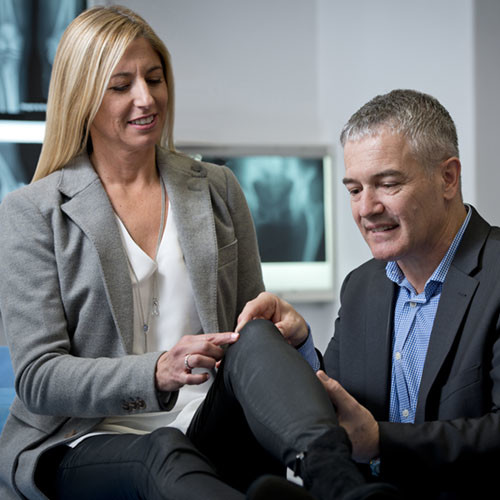
Orthopaedic surgeon examining a patient's knee during a consultation

patellofemoral pain frequently asked questions

Patellofemoral pain is most common in young adults, affecting an estimated 20% of the population. Its symptoms often start gradually, but may appear suddenly following trauma to the knee.

Signs to be aware of include:

  • Localised pain originating from behind the kneecap
  • Vague, aching pain around the kneecap
  • Cracking and/or popping sounds when standing or climbing stairs (without pain)
  • Feelings of weakness or instability in the knee

Pain presenting from patellofemoral pain syndrome is generally of aching type, but may feel sharp on occasion.  It may be aggravated when the knee assumes a bent position, such as while climbing stairs, cycling, squatting, or kneeling.  It may also present following a long period of sitting.

The presence of these symptoms does not necessarily indicate patellofemoral pain syndrome. If you have any concerns, please speak with your GP for further advice.

Patellofemoral pain develops more often in women than in men. This may be due to the width of the pelvis, which increases the angle at which the bones in the knee joint meet each other.

As Patellofemoral pain syndrome can be described as an overuse injury, athletes and manual labourers are more likely to develop the condition. It may also present in people who sit with a bent knee for extended periods of time, such as office workers – sometimes referred to as ‘Moviegoer’s knee’, as many sufferers find it presents after sitting for long periods while watching a movie.

As the name may suggest, patella-femoral pain results from irritation between the patella (kneecap) and femur (thigh bone). This may result from repetitive bending motions, such as those made when climbing stairs, running, jumping, kneeling, or doing squatting exercises. It may also result from an abnormal or increased load on the knee joint (such as excessive weight gain) or may present as a normal ‘developmental pain’.

The articular cartilage behind the knee cap can soften during the teenage growing years and cause pain. Happily, the cartilage seems to toughen up with time (sometimes several years) and symptoms naturally reduce.

Although the exact cause of patellofemoral pain remains unclear, overuse and trauma are believed to be contributors. Patellofemoral pain may also result from misalignment of the muscles surrounding the hip and kneecap, which can impact running and jumping technique.

Prompt diagnosis of patellofemoral pain ensures the best possible outcomes. Patellofemoral pain is most often diagnosed with a history and physical examination conducted by a GP or specialist. X-rays may be ordered to rule out any underlying bone damage or accompanying injury. An MRI may be ordered to assess the ligaments, soft tissues, and alignment of the knee to exclude other causes.

Most cases of patellofemoral pain improve with non-surgical treatment. The aim of treatment is to reduce pain and restore previous levels of motion and strength.

Treatment generally involves reducing the load on the affected knee until the injury heals, such as by reducing activity. This may be supplemented with over-the-counter nonsteroidal anti-inflammatory medication (such as ibuprofen). Physical therapy may be recommended to stretch up the quadriceps muscle, strengthen the muscles around the knee and avoiding aggravating activities. Taping or bracing of the kneecap may be used to take stress off the lower leg during activity.

Surgical treatment for patellofemoral pain is rarely necessary.

Knee treatments

  • Anterior Cruciate Ligament (ACL) Reconstruction

    The anterior cruciate ligament is the most commonly disrupted ligament in the knee. Our understanding of the anterior cruciate ligament and its importance to knee stability has increased greatly over the past 20 years, as has our ability to diagnose

  • Arthroscopic Knee Surgery

    Arthroscopic surgery of the knee is performed using a small telescope (arthroscope) and operating instruments which are inserted through, three punctures (usually) approximately 5 millimetres long. Using this technique, it is possible to remove torn cartilage and other loose pieces

  • Patellofemoral Replacement/​Stabilisation

    Orthopaedics SA’s Adelaide-based orthopaedic clinic is committed to providing high-quality care and treatment for patients with knee joint conditions, including patellofemoral problems. The patella (kneecap) and the femur (thigh bone) meet at the knee joint. When problems arise in this

  • Revision Knee Replacement Surgery

    Revision Knee Replacement means that part or all of your previous knee replacement needs to be revised. Surgery is not a pleasant prospect for anyone, but for some people with arthritis, it could mean the difference between leading a normal

  • Robotic Assisted Knee Surgery

    Robotic surgery utilises computer-assisted planning combined with a robotic arm guided by your surgeon. It is an advancement of a current technology using computer navigation to assist positioning of a joint replacement implant. Used regularly by our surgeons since 2017,

  • Total Knee Replacement Surgery (TKR)

    A total knee replacement is an operation performed on a knee joint damaged by osteoarthritis, rheumatoid arthritis, accidents or sports injuries. It is carried only after other forms of treatment have no further benefit. The knee is commonly referred to

  • Unicompartmental Knee Replacement

    Unicompartmental or partial knee replacement replaces the worn part of the knee whilst retaining the healthy part of the knee. This is not a new concept but there has been resurgence in popularity recently. Better instruments allow for better tissue

Why Orthopaedics SA?

Comprehensive care

From arthritis to sports injuries, we treat a full spectrum of bone and joint conditions to keep you moving.

Expert surgeons

Our highly trained doctors have years of experience delivering precise and effective treatments.

SA’s largest practice

With 23 specialists, we offer unmatched expertise and evidence-based care for every patient.

Multiple locations

We have multiple clinics across South Australia, making it simple to find expert care nearby.

Patient-centric approach

We prioritise understanding your condition to ensure every treatment recommendation feels right for you.

Reliable support

Our team of nurses and administrative staff works behind the scenes to make your experience smooth and stress-free.

We take responsibility for our patient’s experience

From your initial consultation to follow-up care, our team will guide you through every step of your treatment. Your specialist will provide a detailed recovery plan, including physical therapy to restore function and prevent future injuries.

Care

We care for people

Professionalism

We bring our best

Communication

We are open and genuine

Community

We are strongest together

Have questions? We're here to help.

Your records and your care: important information for patients

Doctors will cease consulting patients at Orthopaedics SA from 1 June 2026 and Orthopaedics SA will also be closing down permanently from this date. We want to make sure all of our patients understand what this means for their ongoing care and any medical records held by Orthopaedics SA.

What is happening to my records? Your records will transfer to your surgeon’s new practice on 1 June 2026, so they remain accessible to them as your treating doctor. If your surgeon is retiring, we will transfer your records to the new practice and surgeon they have nominated to continue your care.

What if I don’t want my records transferred? You have the right to opt out. To do so, please contact our rooms:

  1. on 8267 8267 during our business hours of 9.00 am to 5.00 pm (SA time), Monday to Friday; or
  2. by replying to this email: info@orthosa.com.au; or
  3. in person, at your usual Orthopaedics SA clinic,

on or before Friday, 1 May 2026 to discuss your options. We will need to verify your identity, before discussing your records with you. If we do not hear from you by that date, we will proceed with the transfer as described above. We encourage you to speak with your surgeon well ahead of this date, to obtain details of the new practice and how it will handle your personal information.

What if I have more questions? Please contact our clinic directly using the number you already have on file.

Thank you for being a patient of Orthopaedics SA.